

















We at mutualfundwala ponder over this fundamental question every now and then. Why should an individual or a family trust their hard earned savings in the hands of an entity or an individual. This is all the more relevant today as Investors can invest directly and save a part of their expense. This is surely tempting. Ease of investing online and saving part of expense is alluring. However, this Is just one part of the story. With over 2000 schemes in debt and equity category the choice of the scheme has to be correct. Going forward consistent monitoring of investments becomes extremely important. Add to this various servicing needs like change of bank, updating of address, email ID’s, statement of capital gains etc. Hence, a Mutual Fund Distributor may be indispensable. The moot point is “is engaging a distributor worth it ?” . Totally. We shall give you all the tools to make decisions on your own. Weather it is rebalancing of the portfolio with the changing market and political conditions or weening out existing non performing schemes, our portfolio tracker shall enable you with DIY.
Is the Distributor really needed?
In our close interaction with various individuals, from our family of over 5000 investors, this is what we figured out about “ the worth it” distributor.
We take pride in calling ourselves “Distributors to middle class Indians”. We take an extremely calibrated approach to investing. We will communicate all subjective & objective parameters and enable investors to choose a scheme or a product.
Following are five important communication that differentiates Mutualfundwala from other distributors:
Equity Mutual Funds are essentially vehicles which hold ‘shares’ (or part ownership) of various companies. Retail investors view mutual funds as a ‘black box’. This “black box” is viewed with lot of scepticism and negativity. A layman would think mutual funds has a price (NAV) that may go up and down. Mostly down. Fear of losing money will keep investors at bay. As a result, total head count of investors in the Indian Mutual Fund space is barely 2 Cr. A penetration of less than 2%.
What are Mutual Funds, and more importantly how do they work?
Equity Mutual Funds (or Equity oriented Mutual Funds) are essentially vehicles which hold ‘Equity shares’ of various companies. As we know the ‘shares’ of these companies are listed (and traded) on various stock exchange, such as BSE or NSE. When you buy a unit of the mutual fund, the investors’ money is used to buy parts of these companies. The diagram on the right shows a Mutual Fund with the Top 10 listed companies. In India 80% of all equity mutual fund assets are spread across around 150 companies.
How does mutual funds grow your money
Mutual Funds tend to do well, if the companies they invest in do well. Performance of the mutual fund scheme is proportional to the growth in revenues and profits of the invested companies. Secondly, managers of the scheme, comprising, CIO, fund manager and analysts also play an important part. They decide what to buy, what to sell and when to buy and when to sell. How much to buy and how much to stay in cash etc. Lastly, macro-economic variables and sentiments also play a big part in share price movements and hence the performance of the fund.
Here’s the performance of some of the leading companies in India over the past decade. Hence, any equity fund owing these shares would have grown accordingly.
Indian economy is one of the fastest growing economies in the world, growing at close to 12% pa in nominal terms, and it is expected to grow at the same pace for years to come.The incremental growth in the economy in 2018 alone was equal to the size of the economy in 1996. This path of progress is here to stay.
If you want to create wealth, start by owning great companies through mutualfunds. Mutual Funds as a vehicle for you to own ‘shares’ of some exceptional companies has done an exceptional job in wealth creation. You do not need to bother about what to buy or what not to buy. Let the fund managers do their job and you (as investors) will monetarily benefit by investing and sitting tight.
New to the world of mutual funds? This is what we can do for you….
Risk Profiling : Mutualfundwala, will enable you to access your risk appetite. This is the first step in choosing a scheme. At times retail investor has no realisation of his/her risk appetite. Let us illustrate: A working professional nearing 60, with no retirement planning feels that he has a high risk appetite. This thought process is a recipe for disaster. Another individual in the same age bracket with substantial alternate income (eg. Rental income etc) feels he is nearing retirement and has “zero” risk appetite. This too is factually incorrect. A hawkish look at an individual own risk appetite is the starting point in looking at investment products.
State of Equity markets and the Economy: These are 2 extremely relevant factors for any investments for 3-5 years. Mutualfundwala will provide all relevant communication on this. Mutualfundwala will communicate the 2 related pieces (economy and stock prices) so that the prospective investor can chose between debt or Equity on his own.
Tenure of investments. This variable will determine if an individual needs to invest in debt or equity. Investors may invest in high risk equity with risk mitigation tools like SIP or STP. Let us explain; An individual who has saved money for his daughters marriage next year, need not use the equity route. Investment can conveniently go in debt instruments and generate 2-3% higher return than FD. Another investor who is 35 and needs to plan a retirement corpus can easily invest in equity and take the SIP route.
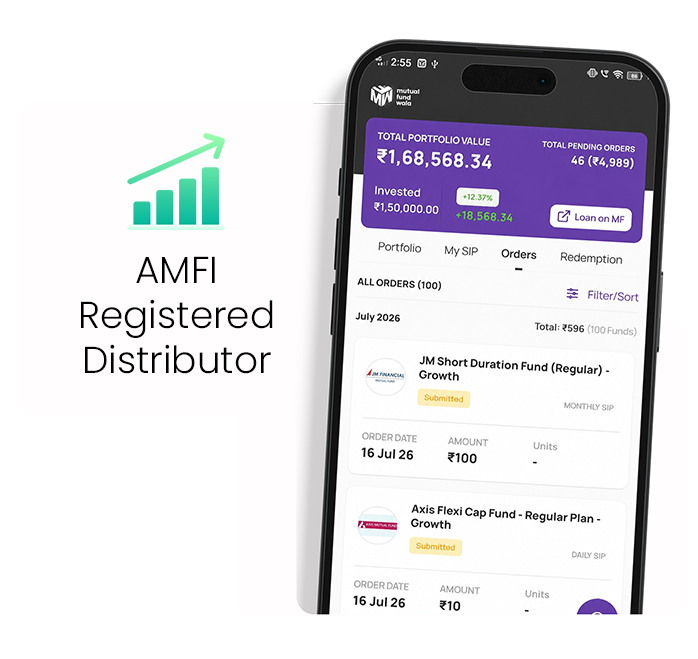
Proactive monitoring of your investments: Once you have invested with Mutualfundwala, we will give you access to a portfolio tracker and a mobile app. They shall enable you to take prompt actions at the click of a button.
We will assist you with your existing investments.
You may have already made some MF investments then this is what Mutualfundwala can do for you :
We use the word “risk” very often, and have little idea as to what is Risk. Risk is defined as the possibility of losing something of value. Risk can also be defined as the intentional action that may lead to unpredictable results. Hence, when an individual (or an investor) exercises a choice or an action that may lead to “unpredictable and uncontrollable outcome” is called risk.
Now let us deliberate on what is risk in financial investments. More so, in equity or Equity mutual funds. We illustrate with an example. An investor, totally new to the word of investing, invests a lump sum amount in a small and mid-cap scheme. A year later he finds his investments down by 50%. Now when the investment decision was made a year earlier, it may have seemed a smart one. There may have been some convincing reasons why small and mid-caps will go up. This Investors financial advisor may have thought likewise. However, all this was done without considering risk. Hence it led to an “intentional action leading to unpredictable results”. This is a disappointing introduction to the world of investing. This is risk and unpredictable result as loss.
Risk can be mitigated on 3 fronts. Firstly, Intentional action is made wiser with investments in low or zero risk products. Secondly, unpredictable results can be made largely predictable. Lastly, dosage of risk is advised as per the investors risk appetite, market valuations and other macro-economic factors.
Mitigation of Risk (in the above illustration) can be done in the following ways…
1. Investor is communicate that results (returns) may come in 5-7 years. Hence, unpredictable outcome is made largely predictable by increasing the time horizon.
2. Investors are given all information on SIP and STP. This will bring down unpredictability.
3. Lastly investor can choose a product after factoring in his/her age, financial status, liabilities etc. Good example is a retired pensioner, leading a comfortable middle-class life. He may choose a “risk free (or negligible risk) product” with risk free returns of 8-9%. Hence, no unpredictable outcomes or unpleasant surprises.
We at mutualfundwala, will give all relevant information for “managing risk”. The “riskometer” in the fund fact sheet is a great tool and is often given in our official communication. We fully understand that investor likes information and wishes to protect downside.
Started operations in April
2005 had 7 investors in
the first month
Jan 2008, the peak of bull
run, had 285 investors and
assets of 7 cr.
MAY 2014: Assets of
70 Cr, 1200 investors when
UPA II came in.
March 2016: AUM of
135 Cr and 3000
active investors
July 2017: AUM over
300 Cr and over 4400 investors.
Employee strength of 14
AUM of over 386 cr.
Over 5300 investors.